
“ The 180-day rule says I am not affected by my time, but I can tell you that I am.
It will be with me until the day I die… never belonging, always on the outside”
- Quote from Survivor
Quick Exit
Leave the site immediately
Press Release – Failures of the State relating to Survivor redress schemes

Dear All,
As Special Advocate, I have and will continue to raise the concerns around exclusions impacting Survivors and Affected Persons relating to State redress schemes and support measures.
Please see the below a published Press Release following a Press Conference held with two Survivors, James and Noel, and with Kathleen Funchion MEP held in Dublin on 26 May 2026.
Thank you to all Survivors and Affected Persons who continue to share their experiences and insights with the Special Advocate office, and for taking the time to read this important document.
My sincere thanks to James and Noel for their powerful contribution to this Press Release and the Press Conference.
Kind regards,
Patricia
FAILURES BY THE STATE – THOUSANDS OF SURVIVORS STILL DENIED RECOGNITION, JUSTICE AND REDRESS
26 May 2026
“Decades ago the State looked at children and branded them ‘illegitimate’
– a cruel, hurtful term we supposedly consigned to history.
Yet today, the government looks at this at those exact same people, now Survivors of institutional abuse, and brands them ‘ineligible’.
We have simply traded one word of exclusion for another.
The arbitrary lines drawn in all redress schemes prove that while the language has changed, the State’s instinct to shut the door on Survivors remains exactly the same.”
The Special Advocate hears from Survivors and Affected Persons, who raise their negative experiences in engaging with redress schemes and supports from the Government.
The Special Advocate is deeply concerned by exclusions from the Mother and Baby Institutions Payment Scheme, the lack of redress for those who were Boarded Out, the poor take up and lack of promotion of the Magdalene Ex-Gratia Redress Scheme, and continued exclusions for Industrial and Reformatory School Survivors from the Supports for Survivors of Residential Institutional Abuse Act 2025, which is causing traumatisation and further harm.
Key issues raised with the Special Advocate in relation to failures by the Government and State bodies have included:
- Government redress schemes reinforce a ‘hierarchy of abuse’ among Survivors.
- Survivors who were Boarded Out have, to date, never received redress.
- Continued exclusions from the Mother and Baby Institutions Payment Scheme cause ongoing hurt to Survivors. Those excluded include Survivors who spent less than 180 days in eligible institutions and those who spent time in mother and baby institutions currently excluded from the redress scheme.
- Magdalene Redress Scheme; Poor Promotion and Advertising of the Redress Scheme resulting in low take up of the scheme. Only 900 have applied and received redress, however 10,000 -12,000 women and girls were incarcerated in these institutions0F[1].
- Recent Supports for Survivors of Industrial and Reformatory School Institutions are only available to those who have previously received redress under the Residential Institutions Redress Scheme and consequently excludes thousands of Survivors in Ireland and Abroad.
Patricia Carey, the Special Advocate for Survivors said:
“Today’s event highlights what hundreds of Survivors have said: redress is exclusionary, challenging to navigate and re-traumatising”
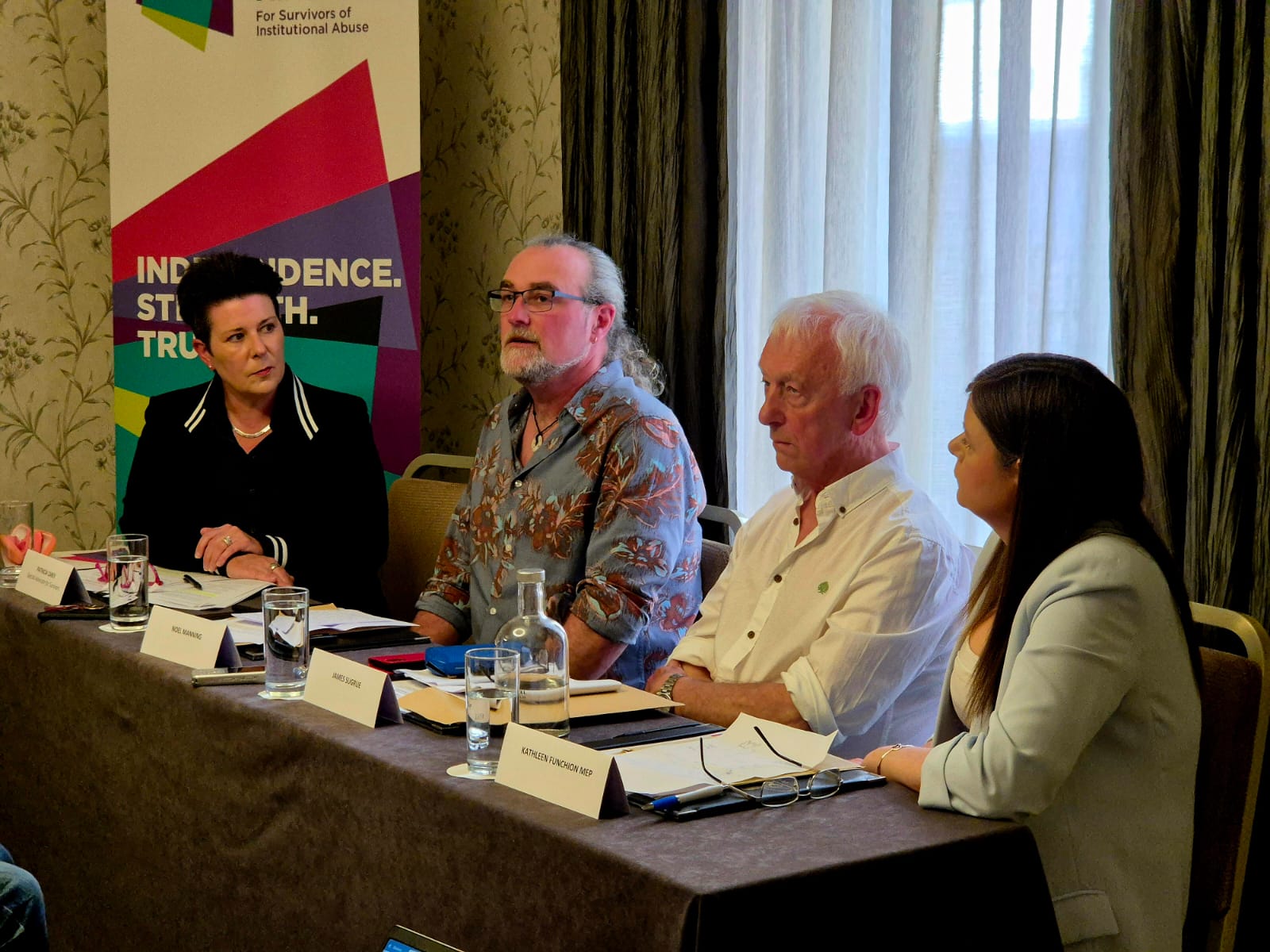
At the Press Conference on Tuesday 26 May 2026, the Special Advocate for Survivors Patricia Carey and Kathleen Funchion MEP are joined by James Sugrue and Noel Manning, who are both Survivors of Ireland’s Institutional Abuse systems.
They are calling for the following:
- Commitment to a meaningful redress package and recognition for those Boarded Out.
- Immediate removal of the 180-day eligibility requirement for Mother and Baby Institutions Payment Scheme.
- Inclusion in redress of all Institutions operating within the network of Mother and Baby and County home institutions, including private nursing homes and other settings.
- Improved Supports and Services, especially health and housing supports, for all Survivors and Affected Persons,
- Commitment by Government to undertake focused promotion and advertising of all available redress and supports available to Survivors, in Ireland and Abroad, in order to ensure Survivors don’t miss out on redress and supports they are entitled to.
[1] www.gov.ie/en/department-of-children-disability-and-equality/services/the-magdalen-restorative-justice-ex-gratia-scheme/
-
-
The idea that a redress scheme arbitrarily dictates who gets compensation due to days spent in the institution seems cruel, unfair and discriminatory
- Quote from Survivor
Kathleen Funchion MEP said:
“We are now in the month of May and there has still been no indication from Government as to when the review of the Redress Scheme legislation will commence. The lack of urgency from government in this area is extremely disappointing, especially for those survivors who have been excluded.
“When the review does go ahead, we want to see the current rule – which excludes anyone who stayed in a Mother and Baby Home for less than 6 months from applying – scrapped. These survivors should be included; regardless of how long or short their stay was.
“We also want to see recognition given to those children who were boarded out and forced to work as unpaid slaves in farms and in private houses. There must also be recognition of the distinct experiences of mixed-race children in these institutions.
“One key element that must be addressed, is ensuring all relevant institutions are covered by the scheme to ensure that no survivors are left behind.
“It is imperative that the religious orders pay their outstanding contributions towards the overall redress costs.
“A major failure of the current scheme is the lack of public awareness and accessibility in relation to the application process. Many applicants are elderly and find it difficult to navigate the website or understand the terminology used. The scheme must also be sufficiently publicised to ensure it reaches all those affected.
“There should be no hierarchy of survivors, and the review must be used as an opportunity to ensure that no one is left behind.”
‘Restitution that Never Came’ – Boarded Out Survivors are still excluded from financial redress, despite repeated recognition of wrongdoing from the State.
The Special Advocate continues to call for the inclusion of all Boarded Out Survivors in a Government redress scheme, regardless of the pathway by which they were boarded out. Many of those children boarded out as young as five experienced horrific abuse, neglect, and worked as unpaid slaves in farms and houses.
- While welcoming the mention of Boarded Out children in the Taoiseach’s recent State Apology, the Special Advocate has made clear that financial redress must now urgently follow for those Boarded Out from all pathways into a Government redress scheme.
- An apology without redress is meaningless. The State must move beyond acknowledgement and take concrete action to address the enduring impact on those who were Boarded Out.
- A Human Rights ‑ based approach is needed, grounded in equality, fairness and the principle of ‘Leaving No One Behind’, to ensure Boarded Out Survivors are no longer treated as a separate or lesser group of Survivors.
Exclusions from the Mother and Homes Institutions Payment Scheme are causing ongoing hurt to Survivors
The Special Advocate warns that State redress schemes and support measures have created a hierarchy of suffering. Currently the Irish State recognises and supports some Survivors while excluding others, resulting in unequal treatment, re‑traumatisation, and a continuation of harm rooted in State policies.
- The Mother and Baby Institutions Payment Scheme:
- Only 7,225 applications have been made two years into a five-year redress scheme.
- This is less than 22% out of the 34,000 people eligible to apply.
- Only 5,300 redress payments have been made (as of April 2026)1F[1]
- €78 million has been spent on redress, an average payment of approximately €15,000 2F[2]
- The outsourced company (Relatecare) operating services for the redress scheme has cost the state €6.88 Million Euro to date (April 2026)3F[3]
- Exclusion from Redress for 24,000 people who spent less than 6 months in an institution4F[4]
The redress scheme excludes many institutions and private settings, including private nursing homes, orphanages, private and children’s hospitals, and other institutions and organisations operating as part of Ireland’s network of Mother and Baby Home Institutions such as Temple Hill and Westbank Orphanage.
- The exclusion of Survivors who died before the State Apology on 13 January 2021, preventing the families of those who have died from making an application for redress.
- Work Related Payments are currently provided for all County Home Institutions but only two of the Mother and Baby Home Institutions leaving many survivors excluded, with no recognition for the work they carried out in challenging circumstances.
- The exclusion of acknowledgment and redress for those who were subject to vaccine and baby formula trials is a glaring anomaly and must be rectified.
- Survivors of different racial or ethnic backgrounds may have had distinct and differing experiences while in institutions. The racial and ethnic experience of Survivors and Affected Persons should be acknowledged as part of the State’s response. While the Mother and Baby Homes Commission of Investigation acknowledged the treatment of mothers and children with ‘different racial and cultural heritage’ little has been done to address this beyond the 2021 State Apology.
[1] DCDE website: April Monthly Infographic
[2] Mother and Baby Homes – Thursday, 23 Apr 2026 – Parliamentary Questions (34th Dáil) – Houses of the Oireachtas
[3] Dáil Éireann Debate, Thursday – 23 April 2026
[4] www.rte.ie/news/2024/0320/1438847-mother-and-baby-redress/
Magdalene Ex-Gratia Scheme – Poor Promotion and Advertising of the Scheme is resulting in low take up of scheme.
Only 900 applications have been received out of 10,000 -12,000 5F[1] eligible to receive redress. A renewed, focused, official communications and promotion campaign for the Magdelene Ex-Gratia Scheme to promote the scheme must take place as a matter of urgency, in Ireland and overseas, to ensure all of those eligible can apply.
[1]About the Magdalene Laundries – Justice for Magdalenes Research
Confusing Application Processes, Lack of Promotion, and Exclusionary Criteria relating to recently launched Supports continue to impact Survivors of Industrial and Reformatory School Institutions
- The Special Advocate for Survivors welcomes the recent introduction of additional supports for Survivors of Industrial and Reformatory School Institutions. She recognises the importance of additional supports including health, education and advocacy supports, and other initiatives in areas such as housing, access to funeral costs supports, and certification relating to court orders that sent children to institutions.
- The Special Advocate for Survivors is extremely concerned that these additional services and support are only available to approximately 9,5006F[1] Survivors of Industrial School and Reformatory Institutions, who have previously received redress under the Residential Institutions Redress Scheme and Caranua Scheme.
- This new support package excludes thousands of Survivors who, for a variety of reasons, including lack of awareness, personal circumstances, or systemic barriers, were unable to apply to the Residential Institutions Redress Board (RIRB).
- The continued reliance on historic redress schemes as a gateway to current supports has created a two‑tier system among Survivors.
- Those excluded are now being denied access once again, compounding past injustice and causing further harm. This approach risks deepening feelings of exclusion and inequality among Survivors.
- A fair and inclusive system must ensure that all Survivors of Industrial School and Reformatory Institutions can access supports, regardless of whether they engaged with previous redress schemes.
[1] https://www.oireachtas.ie/en/debates/question/2025-11-05/110/
Patricia Carey said:
“In my role as Special Advocate, I continue to engage with Survivors, living in Ireland and overseas, who were not aware of previous redress schemes, or were unable to apply for redress at that time, due to lack of support.
Given the aging Survivor population, it is unfair and exclusionary to further discriminate against those who through no fault of their own were unable to or unaware of previous redress schemes”
About James Sugrue
I’ll never forget her words. She said, we heard his screams and we did nothing.
Them words will never leave me.
Because people knew what was going on there. But no one ever did anything
– James Sugrue
James Sugrue was boarded out as a child in Ireland, separated from his brothers and sent to a farm in County Kerry to work unpaid, where he experienced years of exploitation and abuse. Despite these early experiences, he went on to rebuild his life and qualify as a criminal lawyer.
Mr Sugrue is now an advocate for the thousands of individuals who were boarded out as children and remain excluded from State redress schemes. Through his work, he continues to campaign for recognition, accountability, and justice for those Boarded Out.
About Noel Manning
I have been excluded from any past and current redress schemes as I did not end up in the right institution for the right amount of time. I am one amongst many that are being discriminated against in this way.
Back then we were told we were illegitimate. Everyone now agrees that is an awful way to describe children. Yet here we are now again being told by the State we are ineligible.
– Noel Manning
Noel Manning was born in Bessborough Mother and Baby Home in Cork. Shortly after his birth, he was transferred to Temple Hill Institution, Blackrock, Dublin, where he spent the early months of his life in institutional care.
Having applied to the current Mother and Baby Institutions Payment Scheme, he received a Notice of Determination stating that he, like so many others, is ‘ineligible’. The decision was based solely on the time Noel spent in Bessborough and did not take account of the additional time he spent in Temple Hill, as it is not currently an eligible institution under the redress scheme.
Mr. Manning has raised concerns about this exclusion, highlighting the broader issue facing individuals whose full experience of institutionalisation remains unrecognised.
Noel was appointed to the Special Advocate’s Advisory Council in 2025. The Advisory Council will explore key themes of collective concern for Survivors and Affected Persons. Further information is available here.
ENDS
Supporting Documents
Download a copy of the the Special Advocate’s press release below.