
Quick Exit
Leave the site immediately
National Centre for Research and Remembrance
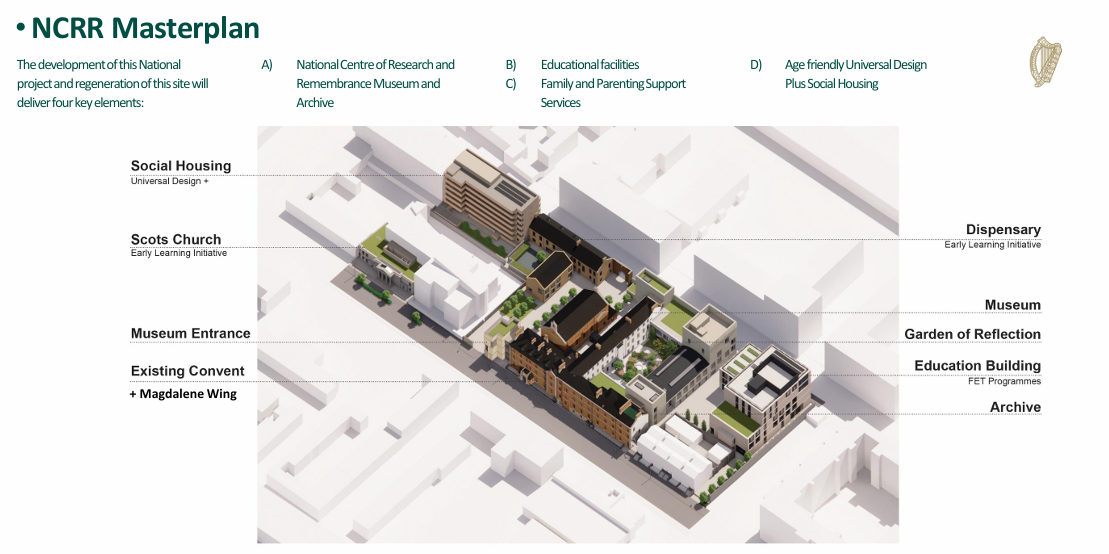
This section on the website contains information about the National Centre, a site of conscience honouring Ireland’s Survivors of Institutional Abuse and Forced Family Separation.
What is the National Centre?
The National Centre for Research and Remembrance will stand as a site of conscience to honour equally all those who were resident in Industrial Schools, Magdalen Laundries, Mother and Baby and County Home Institutions, Reformatories, and related institutions, and all those who have lived experience of Ireland’s historical adoption and boarded out systems.
The National Centre will stand as part of our national institutions and will comprise:
• a museum and exhibition space, the development of which will be led by the National Museum of Ireland;
• a repository of records related to institutional trauma in the 20th century, which will form part of the National Archives; and
• a garden space for reflection and remembrance.
The National Centre campus will also make a valuable contribution to the social and economic development of Dublin’s North East Inner City, through the provision of social housing units, further and higher educational facilities, and facilities for family and parenting supports.
“I would like to highlight the McDermott Street initiative is an outstanding concept. .. I very much commend the Irish Government for its commitment and generous funding. I acknowledge the efforts of all involved in creating a lasting legacy“
“Active involvement of survivors is crucial for ensuring inclusivity in any initiative, and their voices must be central to the design, implementation, oversight, and decision-making of all government-led efforts.“
“Survivors need to be front and centre in shaping the National Centre for Research and Remembrance, especially the memorial centre, garden, museum and reading room for looking at personal records”
“Please start efforts in collecting Survivor and community stories for the National Centre as soon as possible, while people are alive and remember these important stories & experiences“
– Survivor Quotes
Overview of Survivor Engagement and Consultation on the National Centre
For an overview of engagement with Survivors and Affected Persons about the National Centre for Research and Remembrance, please see the overview page of the Gov.ie website: National Centre – Consultation and Engagement
Survivor engagement events – Feedback Report
Events took place in Dublin on 22 October 2024, Galway on 14 November 2024, Cork on 19 November 2024, online on 19 February 2025 and London on 25 February 2025. Attendees at these events heard about plans for the buildings on the National Centre site, work to date on the development of the archival repository, and examples of other survivor-led exhibition and memorialisation spaces. Attendees also had an opportunity to participate in discussions about what they would like to see contained in the National Centre.
Feedback was received from attendees in a number of ways including in person and via written feedback cards at the events, and through follow-up communications from attendees to the organisations involved, such as the National Museum, National Archives and Special Advocate’s Office.
To read the feedback report from the Survivor engagement events which took place in Dublin, Cork, Galway in 2024 and online and in London in 2025, please click below. A copy of graphic recordings from these events can also be viewed.
The presentation from the in person engagement events is available here
Commitments from the National Centre Steering Group
In response to feedback from Survivors and Affected Persons through the series of engagement events, the Steering Group for the National Centre has committed to actions to address each theme which will help to inform the ongoing work on the National Centre, and future engagement.
| Key Theme from Survivor feedback | Details |
|---|---|
| THEME 1: Survivor involvement and decision-making in the development of the National Centre and its ongoing governance | A huge amount of attendee feedback spoke of the need for the involvement of survivors and affected people in shaping the National Centre. There was concern that decisions are being made without survivor input and commitments were sought around future engagement on key elements of the project. |
| THEME 2: Survivor representation within the Museum element of the National Centre | Many attendees spoke about the scope of the National Centre, and the need to represent all those impacted by the networks that existed within the state, including – for example – stories of those who were adopted and boarded out. In addition, many noted that the allocation of space within the museum to the various types of institutions will need to be carefully thought out. |
| THEME 3: Survivor lived experience and the importance of truth | Attendees consistently spoke about the need for the museum within the National Centre to be a place of truth, and a space which acknowledges the intergenerational trauma experienced by many. Several attendees also indicated the desire to see those who have fought for justice for survivors to be acknowledged. In addition, many mentioned the need to include survivors’ experience in their own words, and some asked that the National Centre would facilitate the recording of this in some way |
| THEME 4: The use of the site by survivors once opened | There were many questions about how the space will operate once opened, and suggestions with regards to best practice. The need for a trauma-informed environment was reflected strongly in the feedback, as well as the need to support survivors both within the space and in terms of practical issues, like how to travel there. The use of plain language was also noted as being important. |
| THEME 5: Records and access to them | Access to records was a major issue for many who attended the events. Some had questions about who would be able to access particular records, with several people noting that facilitating survivor access to their own records, and ensuring they have control over access, should be central. Many also noted the need to have the option to add to their records, with a personal statement or similar. Some expressed concern about records held privately, such as by religious bodies. |
| THEME 6: Local memorialisation and engagement with those overseas | Attendees noted the importance of local memorialisation, for example at the sites of former institutions, as well as the need for the National Centre to facilitate travelling exhibitions both within Ireland and internationally. Several people asked about plans to engage survivors abroad, and emphasised the need to ensure this is not forgotten when planning the National Centre. |
| THEME 7: Feedback on the engagement events and future engagement | Many attendees shared feedback on the events themselves, with some finding the sessions interesting and informative and others suggesting improvements for future engagement |
Most notable of the actions was that the Steering Group itself – which is responsible for developing the overall vision of the Centre – would be expanded to include four survivor members. An expression of interest process ran during August and September 2025, and the four survivor members have now been appointed. These members are full members of the Steering Group, alongside the Special Advocate for Survivors and members from Government departments and agencies.
Some other key commitments include:
- The establishment of dedicated panels of survivors and affected persons by the National Museum of Ireland, to inform the development of the museum element of the National Centre.
- A central role for survivors in the governance of the National Centre, once it opens.
- The finalisation of a process to allow survivors and affected persons to share their lived experience – and/or physical items – with the National Museum, if they wish to do so.
- The design of a programme to capture and gather survivor’s personal statements or records as part of the institutional records of the National Archives or to deposit them as private papers.
- Engagement with local museums and community spaces, like libraries, and travelling exhibitions to ensure people can access museum content from different locations.
- Ongoing work on the digitisation of records, to allow those who can’t visit the National Centre to access their records.
The Steering Group response document and a summary infographic are available to view below.
Work on the development of the museum and exhibition space is being led by the National Museum of Ireland, while work on the repository of records related to institutional trauma in the 20th century, is being led by the National Archives.
National Museum of Ireland Lived Experience Experts Panels (ongoing opportunities)
More information about the work of the National Museum in relation of the National Centre can be found here: Museum
The Steering Group has committed to the co-creation of the National Centre museum through collaboration and partnership between survivors, affected persons, and the National Museum of Ireland. To begin the collaboration process, the National Museum of Ireland has invited survivors and affected individuals to participate in Lived Experience Expert Panels. These panels are open to new members and will play a crucial role in guiding the development of the museum element of the National Centre.

If you are interested in joining the Museum’s Lived Experience Expert Panels, or have any questions or feedback, we welcome you to contact museum staff at ncrr@museum.ie
National Archives of Ireland – Advisory Council
More information about the work of the National Archives in relation of the National Centre can be found here: Archive
It is anticipated that at least one survivor representative will be appointed to the National Archives Advisory Council. This is a body established under the National Archives Act to advise the Minister on all archival matters.
For questions or queries, please contact Archive staff at query@nationalarchives.ie
Further Information about the National Centre project
Keeping Updated – Department of Children, Equality and Disability (DCDE)
The Department of Children, Disability and Equality holds an email contact list in order to issue updates to those with an interest in issues relating to the National Centre for Research and Remembrance.
If you would like your email address to be included on this contact list in order to receive future updates, please send an email to nationalcentre@dcde.gov.ie requesting that your details be included.
When the Department receive your request, they will update our contact list and confirm your inclusion by a return email.
You can also contact the team on nationalcentre@dcde.gov.ie if you have any queries at all on the National Centre project.
Frequently Asked Questions
For more information about different aspects of the National Centre project, please read the Frequently Asked Questions page on the National Centre website. Frequently Asked Questions
Location of the National Centre
The National Centre for Research and Remembrance will be located on Sean MacDermott Street in Dublin 1.
Development of the National Centre – Steering Group
A Steering Group – chaired by the former Secretary General to the Government and current Ambassador of Ireland to Great Britain, Mr Martin Fraser – is driving the work on the development of the National Centre for Research and Remembrance.
In addition to the chairperson, the Steering Group includes the following members:
- Three survivor representative members
- The Special Advocate for Survivors of Institutional Abuse
- Department of Children, Disability and Equality
- Department of An Taoiseach
- Office of Public Works
- Department of Culture, Communications and Sport
- National Archives of Ireland
- National Museum of Ireland
- Department of Education and Youth
- Department of Further and Higher Education, Research, Innovation and Science
- Department of Housing, Local Government and Heritage
- Dublin City Council
- North East Inner City Initiative